
In a world where people are increasingly conscious of what they eat, a new approach to vegetarian living can be built around a simple idea: eat vegetarian, avoid added oil, and avoid added sugar.
This approach can be called Vegos.
A Vegos is a person who follows a vegetarian lifestyle and chooses not to consume non-vegetarian foods, added cooking oil, or added sugar. Instead, the focus is on simple, wholesome foods such as vegetables, fruits, legumes, pulses, whole grains, nuts, seeds and other minimally processed foods.
What Does Vegos Mean?
The word Vegos represents a lifestyle built around three basic principles:
VEG + NO ADDED OIL + NO ADDED SUGAR
A Vegos does not eat meat, chicken, fish or eggs. The lifestyle also avoids adding oil during cooking and avoids added sugar in foods and beverages.
The idea isn’t necessarily about eating less food. It is about becoming more conscious of what goes into the food.
The Three Core Principles of Vegos
1. Vegetarian
The foundation of Vegos is vegetarian eating.
A Vegos can build meals around foods such as:
- Vegetables
- Fruits
- Dal and pulses
- Rajma and chole
- Whole grains
- Millets
- Nuts and seeds
- Soy and other plant proteins
- Dairy, depending on the individual’s version of the lifestyle
The goal is to obtain nutrition from a diverse range of vegetarian foods.
2. No Added Oil
The second principle is avoiding added cooking oil.
Instead of frying foods or adding oil during cooking, Vegos meals can use techniques such as:
- Steaming
- Boiling
- Pressure cooking
- Baking
- Air frying without added oil
- Grilling
- Cooking with water or vegetable-based sauces
This does not mean avoiding all dietary fat. Foods such as nuts, seeds, soy and dairy naturally contain fat.
The distinction is no added oil, rather than no fat whatsoever.
3. No Added Sugar
The third principle is avoiding added sugar.
That means limiting or eliminating foods and drinks containing added sugar, such as:
- Sugary soft drinks
- Sweets
- Desserts
- Sugar-sweetened tea and coffee
- Sweetened packaged foods
- Many highly processed snacks
Naturally occurring sugars in foods such as fruits are different from added sugar.
What Does a Typical Vegos Meal Look Like?
A Vegos meal doesn’t have to be complicated.
For example, a balanced meal could include:
Dal + vegetables + whole grain + salad + a protein source
Another meal could be:
Rajma + vegetables + rice + salad
Or:
Soy-based protein + mixed vegetables + millet/roti + salad
The emphasis is on creating meals from nutritious ingredients rather than relying heavily on processed vegetarian foods.
Vegos Is More Than Vegetarianism
Vegetarianism generally describes what a person does not eat.
Vegos adds two additional principles:
Vegetarian + No Added Oil + No Added Sugar
This creates a more specific eating framework.
Someone can technically be vegetarian while consuming large amounts of fried foods, sweets, sugary drinks and highly processed foods.
The Vegos philosophy attempts to move the focus toward simpler and less processed food choices.
The Importance of Protein
One potential challenge with any vegetarian eating pattern is getting enough protein.
A Vegos lifestyle should therefore include deliberate protein sources.
Examples include:
- Soybeans
- Tofu
- Tempeh
- Soy chunks
- Lentils
- Dal
- Rajma
- Chickpeas
- Peas
- Dairy products, if included
- Nuts and seeds
A healthy eating pattern should not simply remove foods. It should replace them with nutritionally useful alternatives.
Vegos Does Not Mean Eating Only Salads
A common misconception could be that an oil-free vegetarian lifestyle means eating salads all day.
It doesn’t.
A Vegos diet can include substantial, satisfying meals based on legumes, grains, vegetables and protein-rich foods.
The objective is not to make food boring or extremely restrictive. It is to create a simple set of principles that can guide everyday food choices.
Whole Foods at the Centre
The strongest version of the Vegos concept would place whole and minimally processed foods at its centre.
A simple rule could be:
The closer a food is to its natural form, the more important it should be in the Vegos diet.
This doesn’t mean every processed food is automatically unhealthy. It simply encourages people to make minimally processed foods the foundation of their diet.
What Vegos Is Not
Vegos should not automatically be presented as:
- A crash diet
- A starvation diet
- A guaranteed weight-loss program
- A medical treatment
- A requirement to eat extremely low calories
Removing oil and sugar does not automatically make an overall diet nutritionally complete.
A person still needs adequate calories, protein, essential fats, vitamins and minerals.
For people with specific medical or nutritional needs, professional dietary advice may be appropriate.
The Vegos Philosophy
At its core, Vegos can be summarized in a few simple ideas:
Eat plants.
Choose whole foods.
Avoid added oil.
Avoid added sugar.
Get enough protein.
Eat enough nutritious food.
Keep it simple.
The philosophy is not about perfection. It is about creating a consistent food framework that makes everyday choices easier.
The Future of Vegos
Vegos could become more than a dietary definition.
It could develop into a broader community around conscious vegetarian eating—with recipes, meal plans, food guides, challenges, restaurants, products, educational content and lifestyle resources.
The simplest definition remains the most powerful:
A Vegos is a vegetarian who chooses to avoid added oil and added sugar as part of a whole-food-focused lifestyle.
Vegos is not about eating less. It’s about becoming more intentional about what you eat.
The Vegos Manifesto
Vegetarian. No Added Oil. No Added Sugar.
Food doesn’t have to be complicated.
You don’t need hundreds of rules, expensive superfoods, or complicated meal plans to make more conscious food choices.
Vegos is built around one simple idea:
Eat vegetarian. Avoid added oil. Avoid added sugar. Choose nutritious, mostly whole foods.
Vegos is not about eating less.
It is not about starving yourself.
It is not about perfection.
It is a framework for making everyday food choices simpler and more intentional.
What Is a Vegos?
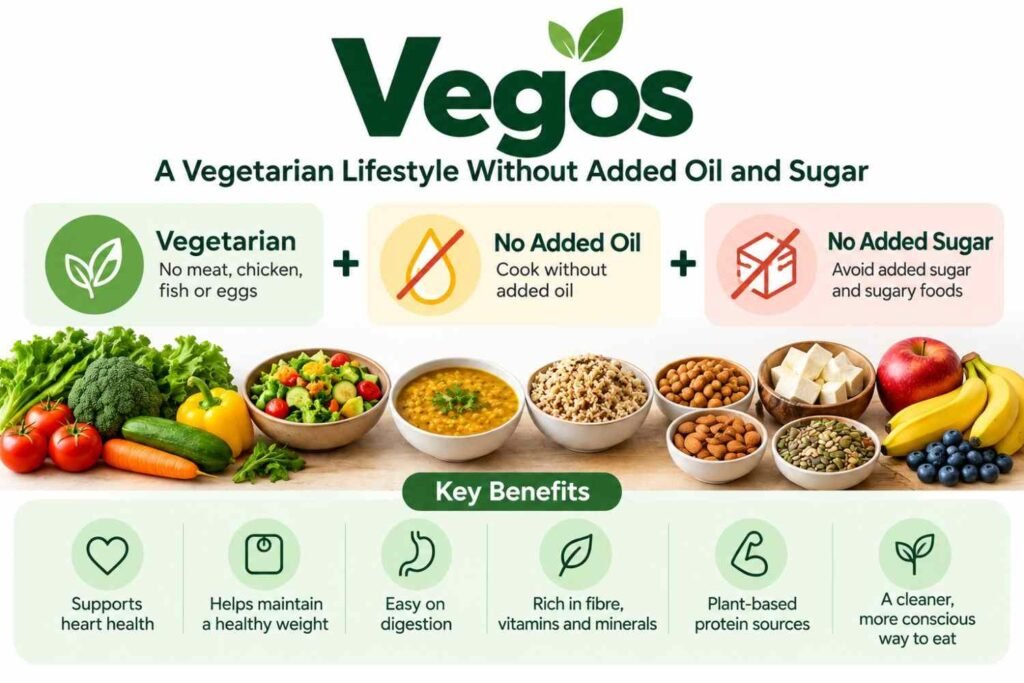
A Vegos is a person who follows three fundamental principles:
1. Vegetarian
No meat, chicken, fish or eggs.
2. No Added Oil
Food is prepared without adding cooking oil.
3. No Added Sugar
Added sugar and sugar-heavy foods and beverages are avoided.
The fourth principle completes the philosophy:
4. Eat Nutritiously
Prioritize vegetables, fruits, legumes, whole grains, pulses and appropriate protein sources while ensuring adequate nutrition.
VEGOS = VEGETARIAN + NO ADDED OIL + NO ADDED SUGAR
The 10 Vegos Rules
Rule 1: Eat Vegetarian
Plants form the foundation of Vegos.
Build meals around vegetables, fruits, pulses, beans, lentils, grains and other vegetarian foods.
Depending on the individual’s interpretation, dairy products may also be included.
Rule 2: No Added Oil
Vegos cooking avoids adding oil during preparation.
Instead, experiment with:
- Steaming
- Boiling
- Pressure cooking
- Baking
- Roasting
- Grilling
- Air-frying without added oil
- Water-based cooking
- Tomato- or vegetable-based gravies
No added oil does not mean no dietary fat.
Nuts, seeds, soy, dairy and other foods naturally contain fat and can contribute to a balanced diet.
Rule 3: No Added Sugar
Vegos avoids deliberately adding sugar to food and beverages.
That means being mindful of:
- Sweets
- Sugary drinks
- Desserts
- Sugar-sweetened tea and coffee
- Sweetened packaged foods
- Foods containing significant amounts of added sugar
Natural sugars found in whole fruits are different from added sugar.
Rule 4: Make Whole Foods the Foundation
Choose foods that are close to their natural or minimally processed form whenever practical.
Think:
Vegetables → Fruits → Pulses → Beans → Whole grains → Protein sources → Nuts & seeds
Processed vegetarian food isn’t automatically forbidden, but it shouldn’t become the foundation of the lifestyle.
Rule 5: Respect Protein
Vegetarian does not have to mean low protein.
Every Vegos meal should ideally contain a meaningful protein source.
Examples include:
- Dal
- Rajma
- Chole
- Soybeans
- Tofu
- Tempeh
- Soy chunks
- Peas
- Lentils
- Dairy products, where included
- Nuts and seeds
Vegetarian + protein-conscious = a stronger Vegos approach.
Rule 6: Eat Your Vegetables
Vegetables should have a major place on the plate.
Different colours provide different nutrients and make meals more varied.
Think:
Green + Red + Orange + Purple + Yellow + White
Don’t rely on one vegetable every day.
Variety matters.
Rule 7: Choose Food Before Products
A Vegos lifestyle should encourage people to think:
“What food can I eat?” rather than “What packaged product can I buy?”
Fresh vegetables, fruits, pulses and grains don’t need complicated marketing.
Keep food simple.
Rule 8: Drink Smart
Make water the default beverage.
Other unsweetened beverages can be included according to individual preferences and nutritional needs.
Be particularly mindful of liquid calories because beverages can contain significant amounts of added sugar without creating much fullness.
Rule 9: Don’t Confuse Vegos With Starvation
This is one of the most important principles.
Vegos is not a low-calorie diet by definition.
A person can follow Vegos and still eat enough food to meet their energy and nutritional requirements.
The goal is not:
“Eat as little as possible.”
The goal is:
“Choose food consciously.”
Rule 10: Consistency Beats Perfection
Nobody needs to become perfect overnight.
If someone follows the Vegos principles most of the time and occasionally deviates, that doesn’t erase the entire lifestyle.
The objective is to create sustainable habits.
Progress > perfection.
The Vegos Food Pyramid
The Vegos food pyramid can be visualized in five levels.
LEVEL 1 — FOUNDATION
🥦 Vegetables
Make vegetables one of the largest components of your overall diet.
Examples:
Spinach, broccoli, cauliflower, carrots, beans, cabbage, tomatoes, cucumber, pumpkin, gourds, capsicum and other seasonal vegetables.
LEVEL 2 — PROTEIN & PULSES
🫘 Dal, Beans & Plant Proteins
Include protein-rich vegetarian foods regularly.
Examples:
Dal, rajma, chole, lentils, peas, soybeans, tofu, tempeh and soy chunks.
LEVEL 3 — WHOLE GRAINS & STAPLES
🌾 Grains & Millets
Choose appropriate portions of foods such as:
Rice, wheat, oats, barley, bajra, jowar, ragi and other whole grains or millets.
LEVEL 4 — FRUITS
🍎 Fruits
Choose a variety of whole fruits.
Apples, oranges, bananas, guava, papaya, berries, watermelon, melon and seasonal fruits can all fit into a vegetarian eating pattern.
LEVEL 5 — NUTS & SEEDS
🌰 Nutrient-Dense Foods
Nuts and seeds can provide protein, fibre and dietary fats.
Examples:
Almonds, walnuts, peanuts, flaxseeds, chia seeds, sunflower seeds, pumpkin seeds and sesame seeds.
Because these foods are energy-dense, portions can be adjusted according to individual needs.
The Vegos Meal Formula
Instead of giving people a complicated meal plan, Vegos can use a simple formula:
V + P + G + F
V = Vegetables
Add plenty of vegetables.
P = Protein
Add a meaningful vegetarian protein source.
G = Grain or Staple
Choose an appropriate portion of rice, roti, oats, millet or another grain.
F = Fruit
Include whole fruit during the day according to your nutritional needs.
For example:
Dal + mixed vegetables + roti + fruit
or
Rajma + vegetables + rice + salad
or
Tofu + vegetables + millet + fruit
The exact quantities depend on the individual’s age, body size, activity level, goals and nutritional requirements.
The Vegos Plate
A simple Vegos plate can follow this visual principle:
🥦 ½ Plate
Vegetables and salad
🫘 ¼ Plate
Protein-rich vegetarian food
🌾 ¼ Plate
Grains or other carbohydrate-rich staples
Then add fruit separately according to your needs.
This isn’t a rigid prescription. It is a visual framework for building meals.
The Vegos Kitchen
A Vegos kitchen doesn’t need expensive equipment.
The most important tools are simple:
- Pressure cooker
- Steamer
- Non-stick or suitable cookware
- Air fryer, if desired
- Blender
- Basic spices
- Fresh vegetables
- Pulses and grains
The objective is to make oil-free vegetarian cooking convenient.
How to Make Food Tasty Without Oil
Removing oil doesn’t have to mean removing flavour.
Vegos cooking can rely on:
Spices
Cumin, coriander, turmeric, chilli, black pepper, garam masala and other spices.
Aromatics
Ginger, garlic, onion, green chilli and fresh herbs.
Acidity
Lemon, lime, tomato, amchur and other naturally acidic ingredients.
Fresh Herbs
Coriander, mint, curry leaves and other herbs.
Texture
Roasting, grilling, steaming and different cooking techniques can create variety.
Oil is only one way of creating flavour and texture.
The Vegos 30-Day Challenge
The easiest way to understand Vegos is to try it.
Days 1–7: Remove Added Sugar
Focus on identifying where added sugar appears in your diet.
Remove or significantly reduce:
- Sugary drinks
- Sweets
- Desserts
- Added sugar in beverages
- Sugar-heavy packaged foods
Days 8–14: Remove Added Oil
Start experimenting with oil-free cooking.
Try:
- Dal without tadka oil
- Oil-free vegetables
- Steamed foods
- Pressure-cooked meals
- Grilled vegetables
- Oil-free curries
Learn new cooking techniques.
Days 15–21: Build Better Plates
Start applying the Vegos meal formula:
Vegetables + Protein + Grain/Staple
Focus on balanced meals rather than simply removing foods.
Days 22–30: Make It Your Lifestyle
By now, the objective is no longer simply completing a challenge.
Build your own Vegos routine.
Create:
- 5–10 breakfast options
- 5–10 lunch options
- 5–10 dinner options
- Healthy snacks
- Simple restaurant strategies
- A weekly grocery list
The goal is to make the lifestyle easy enough to continue.
The Vegos Grocery List
A basic Vegos kitchen can start with:
Vegetables
Spinach, broccoli, cauliflower, carrots, tomatoes, cucumber, cabbage, beans, capsicum and seasonal vegetables.
Fruits
Choose a variety of seasonal whole fruits.
Pulses
Moong dal, masoor dal, toor dal, chana dal and other lentils.
Beans
Rajma, chickpeas, black chana and other beans.
Protein
Soybeans, tofu, soy chunks and other vegetarian protein sources.
Grains
Rice, wheat, oats, barley and millets.
Nuts & Seeds
Almonds, peanuts, walnuts, flaxseed, chia and pumpkin seeds.
Flavour
Spices, herbs, ginger, garlic, lemon, tomato and chillies.
What Vegos Does Not Promise
Vegos should not be marketed as a miracle diet.
It does not automatically guarantee:
- Weight loss
- Disease prevention
- Perfect health
- Longer life
- Better fitness
- Nutritional completeness
Those outcomes depend on the overall diet, quantities, activity, sleep, genetics, lifestyle and individual health circumstances.
A vegetarian, oil-free and sugar-free diet can still be poorly balanced if it lacks adequate protein, calories, essential fats, vitamins or minerals.
That is why nutrition matters as much as restriction.
The Vegos Mindset
Vegos isn’t simply a list of foods you cannot eat.
It is a way of thinking about food.
Instead of asking:
“Can I eat this?”
Ask:
“What is this food made of?”
Instead of:
“How many calories can I remove?”
Ask:
“What nutrition am I getting?”
Instead of:
“How restrictive can I become?”
Ask:
“How sustainable can I make this?”
The Vegos Philosophy in 10 Words
Eat plants.
Choose whole foods.
Skip added oil.
Skip added sugar.
Prioritize protein.
Eat enough.
Stay consistent.
The Vegos Promise
Vegos can be built around a simple promise:
We choose food with intention.
We don’t need to make food complicated.
We don’t need to chase every new diet.
We don’t need perfection.
We simply try to make better choices—one meal at a time.
Vegetarian.
No Added Oil.
No Added Sugar.
More Conscious Eating.